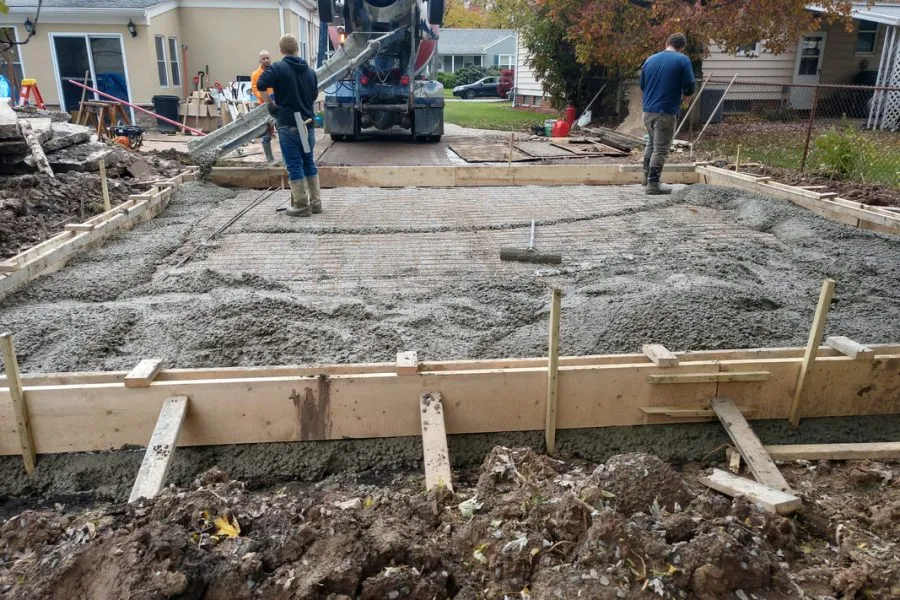
Most home driveways and patios are prepared over one to two days and poured in one. You can walk on the slab in a day or two and park on it in about a week. Nashville weather shifts those times a little in both directions.
How long does it take to pour a driveway?
The pour itself takes a few hours. The whole job usually takes two to four working days: tear-out and grading, stone base and forms, then the pour and finish, then stripping forms and cleanup. Rain, rock that has to be broken or a long steep drive can add days. We give you a schedule with the quote.
How long does concrete take to cure?
Concrete reaches most of its strength in about a week and its design strength in about 28 days. It keeps hardening slowly after that. Curing is a chemical reaction that needs moisture, so a slab kept damp or covered with curing compound in the first week ends up stronger than one left to dry in the sun.
How long before I can walk on new concrete? How long before I can drive on new concrete?
Walk on it after 24 to 48 hours. Keep bikes, wheelbarrows and pets off for the first day or two as well, since they mark the surface. Drive a car on it after about 7 days. Keep heavy vehicles such as a loaded moving truck, an RV or a dumpster off for about 28 days. In cool weather, add a few days to each of these.
Can concrete be poured in the rain?
Not in steady rain. Water falling on the wet surface weakens the top layer and ruins the finish. A light shower after the slab has been finished and has begun to set does little harm if it is covered. Nashville gets about four feet of rain a year and sudden summer storms, so we watch the forecast and move a pour if needed. A day's delay costs less than a damaged slab.
Is it too hot to pour concrete in a Nashville summer?
It is rarely too hot to pour, but the method changes. Above about 90 degrees concrete sets fast and the surface dries before it can be finished. In summer we pour at first light, dampen the base, ask the plant for a mix suited to heat and start curing as soon as the finish is on. Mid-afternoon pours in July are the ones that go wrong.
Can concrete be poured in cold or freezing weather?
Yes, with care. Fresh concrete must not freeze in its first day or two, or it loses strength for good. Middle Tennessee winters are mild on most days, and many winter days are fine for pouring. When a freezing night is forecast we use a mix made for cold, pour early so it gains heat during the day, and cover the slab with insulated blankets. We do not pour on frozen ground.
What is the best time of year to pour concrete?
Spring and fall are the best time of year here, with mild days and cool nights. April and May bring the most rain, so dates move around. Fall is drier and steadier. Summer and winter pours are done all the time with the adjustments above. Do not wait a whole season for perfect weather if the slab is needed.
Can I use salt or deicer on new concrete?
Not in the first winter. Deicer lets water soak in, then refreeze, and a young slab scales under that. Use sand for grip in the first year. After that, use plain rock salt sparingly and shovel first. Avoid products with ammonium nitrate or ammonium sulfate at any age, because they attack concrete chemically. Road salt also drips off your car onto the drive, so rinse the slab when the weather warms.
Questions about your own schedule? Call (615) 436-8921.